
What happens when yesterday’s suspicious folk remedies become today’s respectable pharmaceuticals?
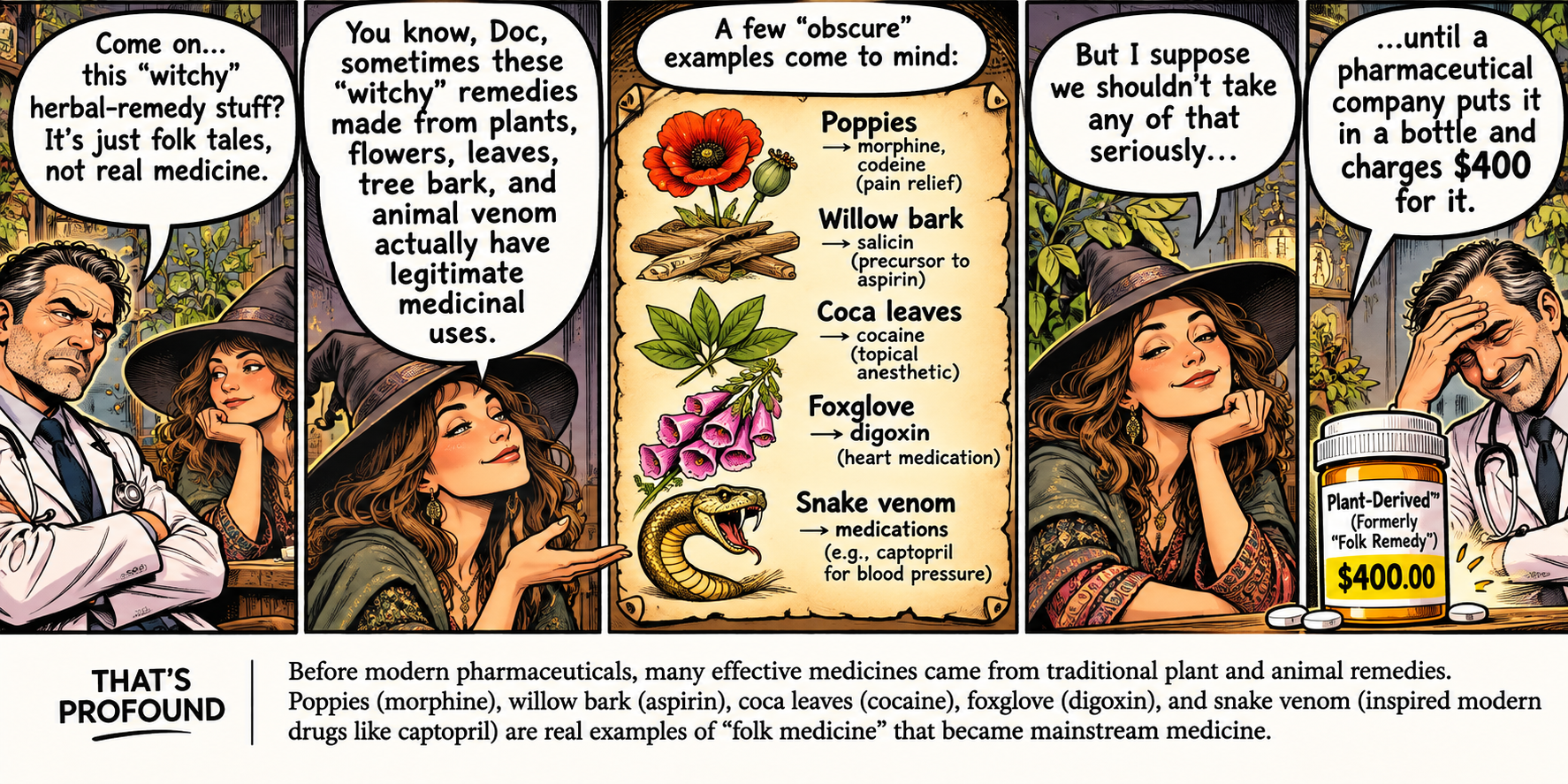
The premise is deliciously simple: A physician dismisses herbal medicine as witchcraft. His skeptical friend asks him to explain morphine, aspirin, cocaine, digoxin, and a blood-pressure medication inspired by snake venom.
Suddenly, the witch’s cauldron starts looking suspiciously like a pharmaceutical research laboratory.
The joke isn’t that modern medicine is fraudulent. Quite the opposite. It’s that modern medicine has repeatedly discovered valuable compounds in the natural world.
The original pharmacists didn’t wear white coats
Long before anyone could identify an active molecule, people noticed that certain plants and substances produced repeatable effects. Some reduced pain. Others affected the heart, numbed tissue, or caused harm. Knowledge traveled through families, healers, apprentices, written traditions, and, yes, plenty of superstition.
Of course, observation wasn't always right. Historical remedies ranged from genuinely useful to useless to dangerous. But dismissing the entire enterprise as nonsense would mean overlooking some of the most important starting points in drug discovery.
Five inconvenient examples
Poppies and morphine. The opium poppy contains morphine, a powerful pain-relieving compound. Ancient people used preparations of opium long before chemists isolated its constituents. That history also includes addiction and overdose: “natural” never meant “harmless.”
Willow bark and aspirin. Willow bark contains salicin and related compounds. Its long association with pain and fever relief helped inform the history of salicylate medicines. Modern aspirin, acetylsalicylic acid, is chemically distinct from a cup of willow-bark tea.
Coca leaves and cocaine. Cocaine is a plant-derived compound that doctors can still use as a specialized local anesthetic for certain nasal procedures. Its carefully controlled medical role coexists with serious abuse and cardiovascular risks.
Foxglove and digoxin. The foxglove plant gave medicine cardiac glycosides, including digoxin-related compounds. Their effects on the heart are real and powerful. So are the risks of toxicity, which is precisely why standardized dosing matters.
Snake venom and captopril. Researchers investigating peptides from Brazilian pit viper venom helped reveal a pathway for controlling blood pressure. The work contributed to development of captopril, an early ACE-inhibitor medication. No, doctors are not prescribing a spoonful of raw venom.
The word “witchcraft” makes the argument even more interesting
In the old European imagination, knowledge that looked mysterious could attract suspicion. But history demands some care here: the English word “witch” does not have an established literal meaning of “knowledge,” and “witchcraft” is not a proven translation of “knowledge plus strength.” The Old English cræft did carry senses of skill and power; the etymology of witch is more complicated.
Nor were all accused witches herbal experts. Many were ordinary people caught in fear, conflict, and persecution. Still, the history of healers, cunning folk, and traditional plant knowledge invites a useful question: how often do we dismiss an observation because we dislike the person, tradition, or language that brought it to us?
Where the doctor gets the last scientifically valid word
Our skeptical physician deserves one important concession. Discovering that a plant does something is not the same as proving that a particular preparation is safe, effective, consistently manufactured, or appropriate for a specific patient. The dose matters. So do purity, interactions, clinical outcomes, and adverse effects.
Science did not simply put a fancy label on folk medicine. It tested claims, separated promising compounds from unsupported remedies, synthesized improved versions, and established standards that traditional practice often lacked. Much of that work is genuinely extraordinary.
But those achievements do not erase the origin story. Nature supplied the starting chemistry in all five of these cases. Human curiosity noticed some of its effects, and science turned selected discoveries into medicines.
The $400 punchline
A price tag is not evidence of effectiveness, and the comic’s $400 bottle is a joke, not an actual price quote for a named drug. But it does expose a funny habit of mind. Put a remedy in an old-fashioned bottle, and some people scoff. Put a validated compound into a clinical formulary, and they properly take it seriously. The crucial difference is the evidence, not whether the molecule originally grew on a tree or slithered through a rainforest.
So here’s the question for Doc: If a molecule works, did it become effective when we learned how to explain it? Or was nature doing chemistry all along?
Maybe. Maybe not. But it made me think.
Further reading
Historical overview of natural products in drug discovery
FDA: approved cocaine hydrochloride nasal solution
DailyMed: cocaine hydrochloride nasal solution prescribing information
Editorial note: This essay discusses drug history, not self-medication. Natural products can be dangerous, and traditional preparations are not interchangeable with approved drugs.