

You don’t have to be OSHA-certified to have a safe home. Today, I’m taking a closer look at my garage door opener—which, despite its name, spends half its working life as a garage door closer. Lets see how safe it is. Tools required: calibrated intuition, and a volleyball.
Calibrated intuition is judgment developed by comparing instinctive impressions with known standards, observable evidence, and repeated real-world experience.
My garage door suddenly stopped closing. It would travel down a few inches, stop, and then reverse. The problem turned out to be nothing more than a slightly misaligned safety beam—the little red sensor that prevents the door from closing when something is in its path.
Unfortunately, I didn’t discover that first. I assumed the problem was the opener’s downward-force adjustment. I turned it all the way clockwise. No improvement. Then all the way counterclockwise. Still nothing. Only afterward did I notice the misaligned safety sensors and correct the actual problem.
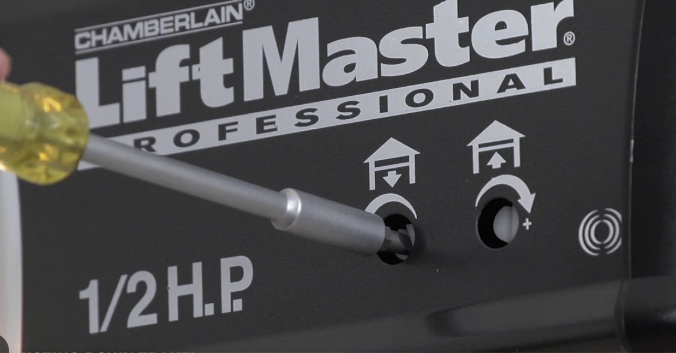
That left me with another problem: I had disturbed the force setting and now needed to readjust it properly.
The manufacturer’s procedure uses the familiar 2×4 test. You lay a 2×4 flat beneath the door and close it. When the door touches the board, it should stop and reverse, demonstrating that it recognizes an obstruction rather than continuing to press downward.
My door passed the official test. But that still didn’t answer the practical question in my head:
How much force was actually supposed to be on the downward travelling door and could it hurt something or someone if its set too high?
The surprising answer is that the official 2×4 test does not tell you how much pressure or force the door applied. It is a pass-or-fail reversal test, not a force measurement. Officially, the opener is supposed to use only enough force to close a properly balanced, freely moving door and, after contacting the obstruction, begin reversing within two seconds. To know the actual peak force, I would need to measure it with a calibrated compression force gauge or load cell. Passing the 2×4 test alone cannot supply that number.
My first thought was to turn a tennis ball into a compression gauge and somehow calibrate it against how much i thought it would/could hurt me or something like the roof of my car if It was in the way–in the absence of ballistic gel. I tried it, the target was a little small, then I realized the ol volleyball (larger} might be a better choice. At the 50-percent downforce setting, the door compressed the volleyball nearly halfway. That looked like a lot to me; it was a fail. I know this is not scientific, but i had to do better than a 2×4 which tells me nothing. At this point i thought i’d lower the force and try the volleyball again.
At the 25-percent down-force setting, the volleyball compressed by roughly a couple inches before the door reversed. I could compress the ball about that much with my hands, so the physical response now looked and felt far more reasonable. Most importantly, the door still passed the manufacturer’s official 2×4 reversal test and otherwise operated as designed, and closed just fine.
The volleyball was not a calibrated force gauge, nor was it a substitute for the required safety test. It simply provided a visible, intuitive comparison that the 2×4 could not. Although it could not prove that the door was harmless to a pet, person, or vehicle, it gave me greater confidence that the opener was no longer applying the excessive pressure I had feared.
That is called calibrated intuition. It does not replace the standard or pretend that a volleyball is laboratory equipment. It combines the formal test with a familiar object whose behavior can be seen, felt, and compared with ordinary experience. The two forms of evidence answer different questions and, together, support a better practical judgment.
My reasoning was:
- The opener’s adjustment range was established by the manufacturer, but that did not mean every setting was equally appropriate for every door. The correct setting was the lowest one that would close my properly operating door reliably. At 25 percent, I was well below the maximum setting I had accidentally selected.
- The 2×4 test established that the door would contact a rigid object and reverse as required. It did not tell me how much force was applied before the reversal began. The fact that the board survived was meaningless—I could drive my truck over a 2×4 without visibly damaging it (the truck would destroy the volleyball).
- Compressing a volleyball by a couple of inches was an amount of deformation I could see, reproduce with my hands, and understand. Crushing or popping the ball would have represented an obviously different and much more alarming result.
This was not a scientific measurement of pounds of force, and it was not proof that injury or property damage was impossible. It was a reasoned comparison layered on top of the manufacturer’s required test.
The garage door did not receive a certificate from an accredited laboratory. It received the considerably rarer Jim Vanpetten Certificate of Volleyball-Assisted Calibrated Intuition.